

The following is a transcript of a Raised Catholic podcast episode.
To listen to the episode, click here.
Today is episode 168: The Spiritual Practice of Awe
Hi friends. As we move toward Holy Week in this springtime of Lent, I find myself noticing the things that are bringing me awe, and I’m letting these moments point me toward what is good, true, and beautiful. Today, I thought I would share some experiences of awe that I had just this week in the hopes that it will help you to look for your own, and to wonder about just what these experiences are teaching you.
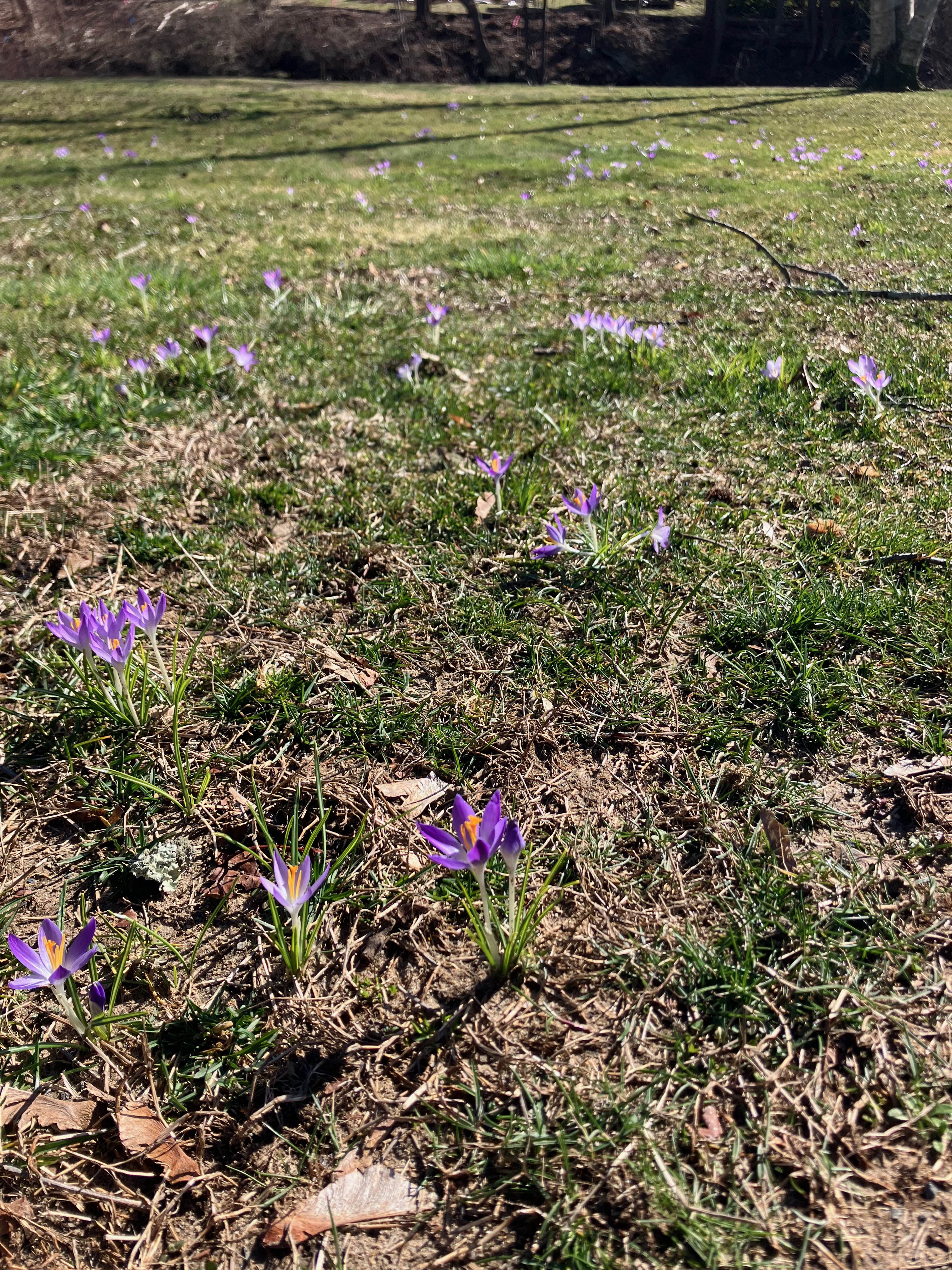
This week I saw my first crocuses, and these little beauties, along with their friends the daffodils never fail to bring me awe. When I see them, I think about their journey through the cold of winter and how they know just when and how to pop up out of the warming ground and astound us in their colorful declaration of hope.
This week I saw a reel on Instagram that brought me awe. It was a short video of a particularly stunning rainbow, which of course rainbows are awe-inspiring always, but the thing about this video clip that really awed me was the number of cars pulled over on the side of the road, the number of people who wanted to stop and take in the beauty of this rainbow. Now, this awed me because it is rare these days for we humans to look up at all away from our technology, isn’t it, let alone to allow ourselves to be awed by a miracle in the sky, a thing that we just could not make on our own. And I guess this little video gave me hope for humanity and that was much-needed awe indeed.
This week I was awed by a costume change in the touring production of Frozen. We’re members at our local theatre, and so we see most of the shows that come through. This audience, though, the audience for Frozen was full to the brim with little girls in costumes and carrying their Elsa, Anna, and Olaf dolls. I mean, it just filled my heart. But there is a moment in the show when Elsa is singing “Let it Go” and she has a crazy fast, almost instaneous costume change that brought a collective gasp to the theatre. When it happened, both my husband and I literally teared up. And I think that this kind of awe – when performers and audience become one collective thing – this is just a stunning thing to be a part of, and it is why live performance is so important to, you know, humanity. I hope we always have it.
This week I was awed by a preschool music student’s answer to a question in class. We were discussing ‘flying things’ because we were getting ready to pretend to be flying things while listening to Vivaldi’s Spring. In this activity, kids will normally choose to be birds, butterflies, or airplanes. Sometimes I’ll hear responses like bees, superheroes, helicopters, kites, fairies, or things like that. This year there were a couple of owls, which made me smile. But this year, a kiddo gave an answer I had never heard before. She was going to pretend to be a flying ghost – and then I heard that same response again later in another class. Now, I have been doing this activity for a very long time, and it’s rare for me to hear something new. I love it when that happens, though, because I am genuinely awed by how a creative preschooler thinks.
This week I was awed by a chocolate croissant. Actually, whenever I eat a croissant or anything made with puff pastry, I am awed by what it takes to create that complicated, flaky perfect dough. As a foodie, a perfect bite, or a perfect balance of flavors will always bring me awe. For example, this week I was awed by Irish Kerrygold butter which, if you have not tried that yet, please do go get yourself some. As I texted my daughter after I tried it, nothing else but Kerrygold butter should even be called butter. It was a revelation for sure.
This week I was awed by singing with friends in what were on the spot, organically created, dense and really stunning harmonies. I was awed by a time lapse video of a plant growing from a seed. I was awed by the documentary, “American Symphony,” and the subjects’ uniquely creative approach to challenges, humanity, and musicianship. I was awed by the last two minutes of the second movement of Beethoven’s 5th Symphony, which always sounds like a rainbow to me. I’ll link that and all of these awe-moments in the show notes for you in case you want to check them out. But also, all week, I was awed by birdsong. Like, how do they know when to start singing and in all those different kinds of ways and what’s it all about, and why is birdsong so gorgeous and hopeful for we humans?
We are awed by the things that we could not accomplish on our own. Awe wakes us up, it produces a reaction, and it lifts us up out of our everyday existence. When we open ourselves to being awed, we can allow God who is the author of awe to point us to the good, true, and beautiful things that are a sign and a guidepost of a life very well lived. These are the transcendentals, the properties of being. Awe is a pathway to not only reading about or learning about or even obeying God, but experiencing Him, for ourselves. Encounter with a God who knows and loves us personally will always bring us awe.
Well, I’d like to close today with a piece of writing that really did awe me this week. It’s from Thomas Merton, an American Trappist monk and author who died in 1968. Merton was a contemplative and mystic whose beautiful writings offer a way into that experiential or relational encounter with God. Here’s a bit from Chapter 5 from Merton’s book, Seeds of Contemplation.
“A TREE gives glory to God by being a tree. For in being what God means it to be it is obeying Him. It “consents,” so to speak, to His creative love. It is expressing an idea which is in God and which is not distinct from the essence of God, and therefore a tree imitates God by being a tree.
The more a tree is like itself, the more it is like Him. If it tried to be like something else which it was never intended to be, it would be less like God and therefore it would give Him less glory.
No two created beings are exactly alike. And their individuality is no imperfection. On the contrary, the perfection of each created thing is not merely in its conformity to an abstract type but in its own individual identity with itself. This particular tree will give glory to God by spreading out its roots in the earth and raising its branches into the air and the light in a way that no other tree before or after it ever did or will do.
Do you imagine that the individual created things in the world are imperfect attempts at reproducing an ideal type which the Creator never quite succeeded in actualizing on earth? If that is so they do not give Him glory but proclaim that He is not a perfect Creator.
Therefore each particular being, in its individuality, its concrete nature and entity, with all its own characteristics and its private qualities and its own inviolable identity, gives glory to God by being precisely what He wants it to be here and now, in the circumstances ordained for it by His Love and His infinite Art.
The forms and individual characters of living and growing things, of inanimate beings, of animals and flowers and all nature, constitute their holiness in the sight of God.
Their inscape is their sanctity. It is the imprint of His wisdom and His reality in them.
The special clumsy beauty of this particular colt on this April day in this field under these clouds is a holiness consecrated to God by His own creative wisdom and it declares the glory of God.
The pale flowers of the dogwood outside this window are saints. The little yellow flowers that nobody notices on the edge of that road are saints looking up into the face of God.
This leaf has its own texture and its own pattern of being and its own holy shape, and the bass and trout hiding in the deep pools of the river are canonized by their beauty and their strength.
The lakes hidden among the hills are saints, and the sea too is a saint who praises God without interruption in her majestic dance.
The great, gashed, half-naked mountain is another of God’s saints. There is no other like him. He is alone in his own character; nothing else in the world ever did or ever will imitate God in quite the same way. That is his sanctity.”
Gosh, I love Thomas Merton. I highly recommend reading on in Seeds of Contemplation if you want to hear more about what Merton has to say about you and me and our identity, how being who we are made to be is what praises God and is really the work of our lives. For today, I hope you have found a little window to a little more awe in your life. As we open up that window, we let in more light and air, more hope and joy, and the truth, goodness and beauty that is God and is His love and plan for us. In this Holy Week as we walk with Jesus, let’s let it all of the awe in.
Thanks so much for being with me today, friend. If you need me, you can find me on Instagram @kerrycampbellwrites, at Substack at kerrycampbellwrites.substack.com, or on my website at kerrycampbell.org. Thanks so much for rating, reviewing, subscribing and most importantly, sharing this podcast with a friend. That makes a real difference in growing our community, so thanks. If you would like to support this podcast financially, there are a couple of ways for you to do that in the show notes, along with some resources related to today’s episode (all of those awe-moments I talked about earlier), so do check all of that out, but before we go, let’s pray together.
In the name of the Father and of the Son and of the Holy Spirit, amen.
God, in your kindness you have created beauty for us to explore and take in, especially in this springtime of Lent. Help us to be awed by the wonder of what you have made in nature, in art, and in people too. And help it guide us to the wonder that is You and Your love for us. We pray for all of this and our dear ones too, in Jesus’ name and wrapped in the mantle of Our Mother Mary, amen.
Thanks so much for listening today, friend. I am praying for your blessed Holy Week, and I’ll see you next time.
Show Notes
This week we’re considering the spiritual practice of awe, and how moments of awe can point us to what is good, true and beautiful, to the very nature of God.
If you’d like to connect with me, find me on Instagram, at my website, or on Substack. If you’d like to help support this podcast financially, there’s a way to do just that on my page at buymeacoffee.com! Thanks for sharing, subscribing, rating, and reviewing, as this helps our community to grow.
Thanks as always to my friend, Peter Vaughan-Vail, for providing the beautiful harp music you hear in this and every episode.
Here are some resources to help you dig into this week’s topic on your own:
1. The ”rainbow” IG reel I talked about in today’s episode
2. Video: Frozen on Broadway Elsa quick-change complilation
3. Song: Spring, from The Four Seasons, Vivaldi (Beethoven’s Wig edition)
4. Butter: Kerrygold Pure Irish Butter (salted)
5. Documentary trailer: American Symphony
6. Song: Beethoven’s 5th symphony, 2nd movement (you’ll find the rainbow in the last two minutes)
7. Book: New Seeds of Contemplation, by Thomas Merton
Correction: The Merton quote I read should say, “and the bass and trout hiding in the deep pools of the river are canonized by their beauty” I mistakenly said, ‘the water’. Thanks for your understanding.

Leave a Reply